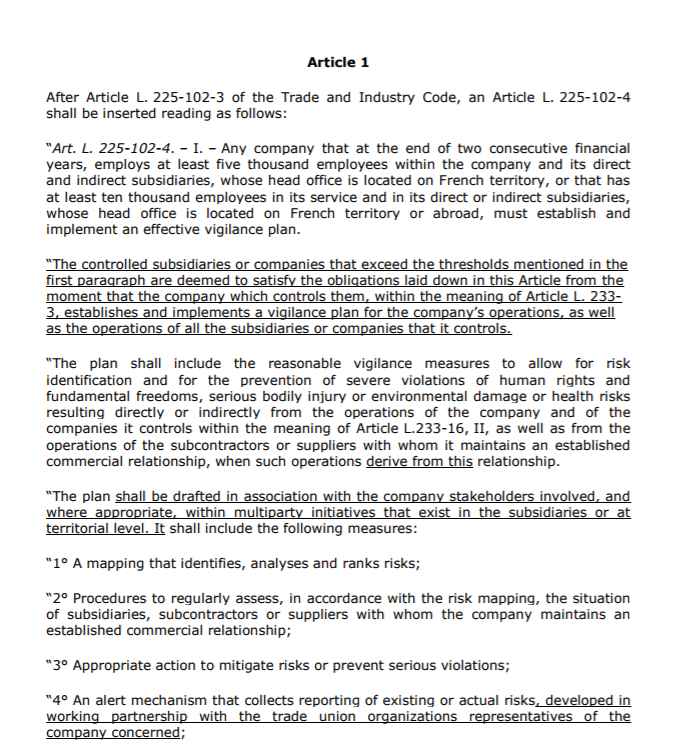
In 2017 the French Parliament adopted the Corporate Duty of Vigilance Law.

The law, which only applies to the largest French companies, will make the latter assess and address the adverse impacts of their activities on people and the planet, by having them publish annual, public vigilance plans. This includes impacts linked to their own activities, those of companies under their control, and those of suppliers and subcontractors, with whom they have an established commercial relationship.

When companies default on these obligations, the law empowers victims and other concerned parties to bring the issue before a judge. Judges can apply fines of up to € 10 million when companies fail to publish plans. Fines can go up to € 30 million if this failure resulted in damages that would otherwise have been preventable.

An English translation of the law, as well as an FAQ by the European Coalition of Corporate Justice are available for download below.

French Corporate Duty of Vigilance Law DOWNLOAD
French Corporate Duty of Vigilance Law FAQ DOWNLOAD

post

page

attachment

revision

nav_menu_item

custom_css

customize_changeset

oembed_cache

user_request

wp_block

wp_template

wp_template_part

wp_global_styles

wp_navigation

wp_font_family

wp_font_face

acf-taxonomy

acf-post-type

acf-field-group

acf-field

ai1ec_event

exactmetrics_note

Decent Work for Ugandan Domestic Workers: Findings and Recommendations for Funders
Legislation

In Uganda and Kenya, thousands of Ugandan children work as domestic workers. Despite laws prohibiting employment of children under the age of 16 in Uganda, there is little enforcement in the domestic work sector. While poverty drives children to ent...Read More

TAGS: Africa
The Impact of Covid-19 on Modern Slavery and Child labour: How can lawyers make a difference? – International Bar Association
COVID-19 resourcesLegislationWebinars

According to the 2017 Global Estimates of Modern Slavery published by Alliance 8.7, 40.3 million people were estimated to be victim of modern slavery in 2016. Modern slavery is not defined in law and it is used as an umbrella term to refer to ‘sit...Read More

TAGS: Global
Global Justice: Using Strategic Litigation to Combat Forced Labour
News & AnalysisStandards & Codes of ConductLegislation

Forced labor is a feature, not a bug, in today’s global economic system. Forced labor spans the globe. It involves multinational corporations. It is found in special economic zones—and war zones. And it is in everyone’s backyard. Globally, 27....Read More

Legislative Scrutiny: Nationality and Borders Bill (Part 5)—Modern Slavery: Eleventh Report of Session 2021-22
Legislation

Part 5 of the Nationality and Borders Bill makes changes to the law on modern slavery. Some of the provisions place in law processes that are currently contained in policy or guidance, but often with some amendment. Other provisions amend existing s...Read More